
How Arrest Warrants Work in Chippewa County
A Chippewa County arrest warrant is a court order that tells a peace officer to take a named person into custody and bring that person before the court. Michigan law sets a firm sequence first. There must be a proper complaint, sworn allegations, and a judicial finding of reasonable cause before a judge or a district court magistrate will sign one. Most local cases open at the 91st District Court on Court Street, and a felony stays there through arraignment, bond, and the preliminary examination. If the court finds probable cause, the case is bound over to the 50th Circuit Court. That split matters when you pick up the phone. The court holding the case today is the one that can speak to the warrant, so call there rather than guessing.
How a Chippewa Arrest Warrant Starts With a Complaint
The process in Chippewa County is written down and moves in order. A police agency or prosecutor prepares a complaint describing the alleged offense. That complaint is sworn before a magistrate or clerk, and a judge or magistrate then decides whether reasonable cause exists. The court can issue an arrest warrant or send a summons instead.
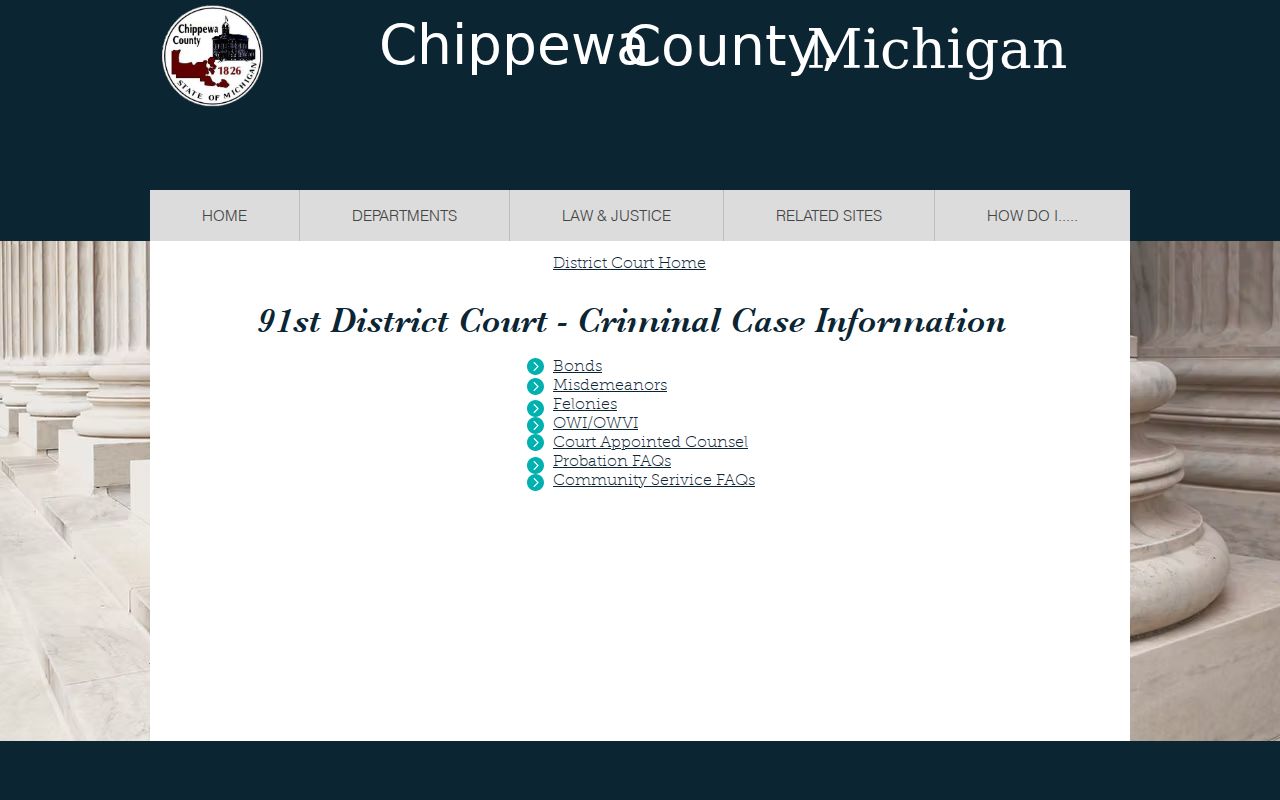
The District Court's criminal case hub splits bonds, misdemeanors, felonies, and OWI matters onto their own pages. Whatever route the court picks, the order names the person and the charge, commands an arrest, and may set interim bail or conditions. Chippewa County readers can use those pages to track where a case stands.
Arrest Warrants: What They Contain
The document carries a defined set of fields. The first two identify the case. The rest explain what happens next in Chippewa County court.
| Case number | The court file identifier, entered on the state portal as Case Number. No separate warrant-number pattern is published |
|---|---|
| Named subject | The person the warrant authorizes an officer to take into custody |
| Charge or offense | The statutory description and its classification |
| Issuing judge or court | The judge or magistrate who signed it, and the court that entered it |
| Date issued | When the court entered the order, which starts the one-year voluntary appearance window |
| Bond or conditions | Any interim bail or release condition written on the warrant |
| Return and service | What the serving agency reported back to the court after an attempt or an arrest |
What a Chippewa County Prosecutor Reviews Before a Warrant
A warrant request in Chippewa County never jumps straight from an officer to a judge. The prosecutor's office sits in between. It reviews police reports, then authorizes or denies each warrant request, and the same office prepares and reviews search-warrant applications. The county has published a position description for an assistant prosecutor, and it lays out that review work in plain terms. It describes a job, not any case, but it shows why a request can be declined or sent back for more information. That extra step also explains the timing. A file can sit with the prosecutor for a while before any judge ever sees it, so a slow answer from the court may simply mean the request is still under review.
How Warrants Get Served in Chippewa County
Only a peace officer or another authorized person may execute a warrant. In Chippewa County the Sheriff's Office handles county warrants, and the office lists a Warrant Officer among its functions, though no direct line for that role is published. Service can happen almost anywhere. It might come at a home, during a traffic stop, or when a person walks into a courthouse or police lobby for some other reason. Where and when it happens is an operational call for the serving agency, not something the court schedules. Issuance and execution are separate events, so a court can confirm that a warrant was issued without knowing whether anyone has tried to serve it yet. That gap is worth remembering when you call about an active warrant.
Who Can Serve a Chippewa County Arrest Warrant
Three agencies do most of this work in Chippewa County. Each keeps its own records and phone lines.
Chippewa County Sheriff's Office
325 Court Street, Sault Ste. Marie, MI 49783
906-635-6355
Sault Ste. Marie Police Department
401 Hursley Street, Sault Ste. Marie, MI 49783
906-632-5729
Michigan State Police, Sault Post 82
3900 I-75 Business Spur, Sault Ste. Marie, MI 49783
906-632-2217
City police handle complaints that start inside the city. The Sheriff covers the county, and state police work both Chippewa and Luce counties. The issuing court can tell you which agency a Chippewa County warrant lists.
Arrest Warrants, Summonses, and Bench Warrants
Michigan courts choose between an arrest warrant and a summons at the charging stage. A bench warrant in Chippewa County comes later, after a missed court obligation.
| Feature | Arrest Warrant | Summons | Bench Warrant |
|---|---|---|---|
| What it orders | An arrest and a court appearance | An appearance on a set date | An arrest for a missed obligation |
| Basis | Probable cause of an offense | A charge that does not require custody | Failure to appear or comply |
| Who issues it | A judge or magistrate | The court | The judge handling the case |
| How to respond | Counsel, surrender, and bond | Show up on the date | Appearance, recall, or a resolved obligation |
A summons escalates if the date is missed. An arrest warrant and a bench warrant can both sit on the same person at once, on different Chippewa County cases.
Chippewa County Search Warrants vs Arrest Warrants
A search warrant lets officers look for described evidence in a described place. It is not an arrest order. It also will not answer a Chippewa County resident wondering about their own status.
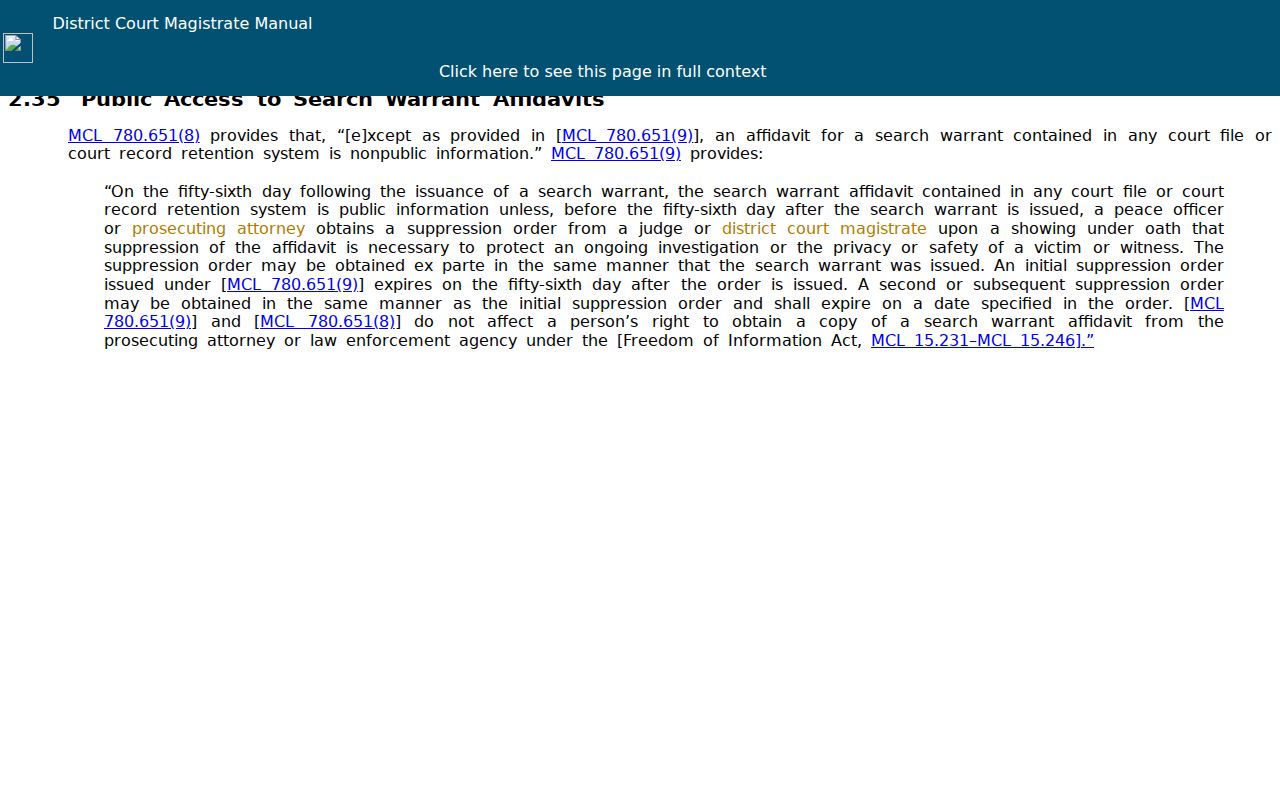
The state's explanation covers a special access rule that keeps a search-warrant affidavit out of the public file at first. Michigan holds those affidavits back until the 56th day unless a judge orders otherwise. An arrest or bench warrant question in Chippewa County belongs with the case file, not with that affidavit.
Handling an Arrest Warrant in Your Name
Do not wait to be found. Confirm the warrant and the issuing court, then work out how to appear with someone who handles these cases. Michigan's voluntary appearance rule gives most people a route to come in on their own within one year, and a Chippewa County attorney can arrange the timing.
- Identify the issuing court and the case number, using MiCOURT or the court clerk.
- Call the issuing court and ask whether a voluntary appearance applies, and what it requires.
- Talk to an attorney about surrender, bond, and whether a recall motion fits the case.
- Keep every document: the case number, the bond receipt, the conditions, and the next date.
Important: Talk to a lawyer before you turn yourself in. An open arrest warrant can surface at any traffic stop, and a planned surrender usually produces better terms than an unexpected arrest.
Who Sets Bond on a Chippewa County Warrant
Call the Chippewa County jail about bond and you will likely get a referral. Judges and magistrates set the number, not the jail. Every criminal case gets its own bond amount, weighed against two things: the risk to a victim or the public, and the odds the person comes back to court. The jail's job is custody and payment logistics. It never closes. It takes cash or a licensed bail bondsman. Checks and foreign currency are off the table. Once bond is posted on a Chippewa County warrant, the jail or an officer hands over a report date. No bond means the person sits for the next available arraignment before a judge or magistrate. Assaultive cases move faster, going to court the next business day unless the court directs otherwise.